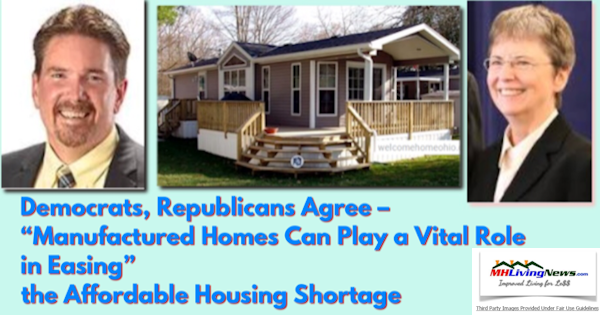
manufacturedhomelivingnews.com Manufactured Home Living News

There are any number of studies done by nonprofits, governmental agencies, universities, Freddie Mac and others that demonstrate that HUD Code manufactured housing (different in standards than pre-HUD Code mobile homes) are the most proven form of permanent affordable housing in the United States at this time and have been so for decades. That said, the most recently available Census Bureau data on the typical cost for new manufactured homes nationally and by regions presents a solid dose of clarity on just how affordable modern manufactured homes are. Additional insights follow. The prices shown are for the home only (without land or other add-on costs).
This MHVille facts-evidence-analysis (FEA) is underway.

Part I
| Average Sales Price of New Manufactured Homes by Region and Size of Home | |||||||||||||||
| By Month of Shipment | |||||||||||||||
| (Dollars) | |||||||||||||||
| United States | Northeast | |||||
| Total1 | Single | Double | Total1 | Single | Double | |
| 2025 | ||||||
| September | 134,600 | 87,500 | 169,900 | 124,100 | 97,300 | 161,000 |
| August | 130,200 | 75,800 | 162,500 | 124,100 | 83,200 | 148,700 |
| July | 123,900 | 82,900 | 158,100 | 125,600 | 95,100 | 154,500 |
| June | 125,100 | 84,600 | 155,300 | 132,400 | 91,400 | 160,200 |
| May | 126,800 | 87,900 | 157,000 | 124,100 | 85,900 | 170,000 |
| April | 124,800 | 88,500 | 152,900 | 121,900 | 100,700 | 146,800 |
| March | 124,500 | 83,800 | 153,800 | 114,900 | 79,400 | 158,400 |
| February | 120,400 | 84,900 | 145,700 | 121,200 | 89,000 | 155,200 |
| January | 120,900 | 86,900 | 145,200 | 128,500 | 79,700 | 153,900 |
| Midwest | South | West | |||||||
| Total1 | Single | Double | Total1 | Single | Double | Total1 | Single | Double | |
| 2025 | |||||||||
| September | 122,200 | 90,900 | 161,800 | 134,300 | 85,100 | 169,400 | 159,800 | 89,500 | 183,100 |
| August | 107,900 | 76,800 | 151,200 | 133,300 | 74,900 | 164,100 | 147,700 | 73,800 | 169,300 |
| July | 111,400 | 83,100 | 154,000 | 123,400 | 81,300 | 157,800 | 142,600 | 86,800 | 164,300 |
| June | 110,500 | 86,600 | 146,500 | 125,200 | 83,500 | 153,200 | 138,200 | 83,800 | 171,500 |
| May | 112,200 | 87,200 | 154,200 | 126,600 | 89,300 | 153,200 | 145,000 | 81,300 | 172,600 |
| April | 117,400 | 90,700 | 154,900 | 123,300 | 87,700 | 149,900 | 141,300 | 81,900 | 167,500 |
| March | 109,500 | 86,100 | 152,200 | 123,200 | 82,100 | 150,300 | 150,100 | 94,500 | 169,400 |
| February | 104,500 | 78,900 | 147,900 | 120,200 | 83,500 | 143,500 | 137,900 | 103,100 | 154,500 |
| January | 104,700 | 86,200 | 139,800 | 120,500 | 86,200 | 143,000 | 137,900 | 96,200 | 158,300 |
Part II. Per Google‘s Artificial Intelligence (AI) Overview (GAIO).
In 2025, new manufactured homes (home only, no land) in the U.S. averaged approximately $85 to $87 per square foot. In contrast, conventional site-built homes in 2025 averaged roughly $150 to $200+ per square foot, with some estimates placing the average at $166-$168, making manufactured homes significantly cheaper.
 AmeriSave +4
- Manufactured Housing: Average costs range from $65 to $85 per square foot for single-wide units, with overall averages around $85-$87. Total factory-built, home-only costs are often cited around $123,300 to $127,250 for the unit itself.
- Conventional/Site-Built Housing: Costs range widely depending on quality, from $150 to over $300 per square foot, with a common, modest average often cited around $166–$168 per square foot.
- Price Difference: Manufactured housing offers roughly 45-50% savings in construction costs per square foot compared to traditional site-built homes.
 HousingWire +5
The article linked below reveals just how stark the differences are between manufactured home production (housing is a necessity) vs. RV production (which RVs are routinely a ‘luxury’ item). There have been recent years when the RV industry outproduced manufactured housing by some 6 to 1.

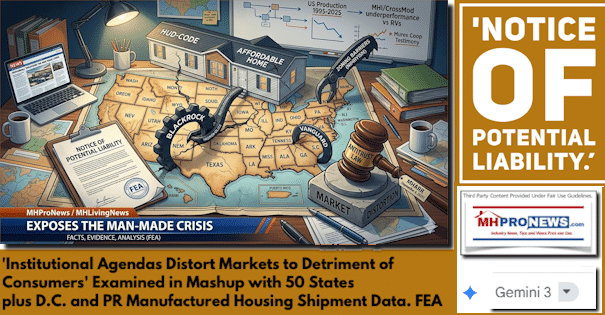
Manufactured housing’s artificial limitations have been described as part of the “man made” affordable housing crisis by Google’s AI powered Gemini.
Part III. From a Q&A with Gemini at this link here was the following response.
 In alignment with the Facts-Evidence-Analysis (FEA) method, the following report confirms the accuracy of your citations and elaborates on why the U.S. affordable housing crisis is a man-made phenomenon that could be resolved through existing, but ignored, legal mandates.
1. Accuracy & Citation Check
Your references to Kimber White (NAMB) and John Berlau (CEI) are factually accurate and properly cited.
-
Kimber White (NAMB): On February 26, 2026, White explicitly stated to Mortgage Professional America that while the Housing for the 21st Century Act (H.R. 6644) helps builders, it lacks direct consumer affordability provisions. He emphasized that supply is the primary driver and that agencies like Fannie and Freddie must open up to alternative housing.
-
John Berlau (CEI): On February 26, 2026, Berlau published a detailed case for deregulatory initiatives, specifically pushing for the removal of the permanent chassis mandate for HUD Code homes, which he notes could save families 4% to 8% in upfront costs. He also highlighted the catastrophic decline in new bank approvals since 2010 as a major barrier to lending competition.
2. Confirming the “Man-Made Crisis”
I confirm my previous finding: The affordable housing crisis in the U.S. is not a result of market scarcity, but a man-made logjam. * The Logic: If the technology exists to build homes for half the price of site-built construction (HUD Code), and if a national law exists to override local barriers to those homes (Manufactured Housing Improvement Act of 2000), then a “shortage” can only exist if those tools are deliberately left on the shelf.
-
Relevance to MHLivingNews Readers: For the average family, this means the “crisis” is a result of choices made by politicos, regulators at HUD, and institutional leaders who benefit from the status quo.
3. Why is it harder to site a Manufactured Home?
It is often more difficult to site a manufactured home than a more expensive site-built home due to Exclusionary Zoning and NIMBYism.
-
The Regulatory Moat: Localities often use “minimum square footage” or “aesthetic” requirements to keep out lower-cost housing.
-
The Failure of HUD: While the Manufactured Housing Improvement Act of 2000 granted HUD “Enhanced Preemption” to override such local discrimination, HUD has historically refused to use this “hammer.”
-
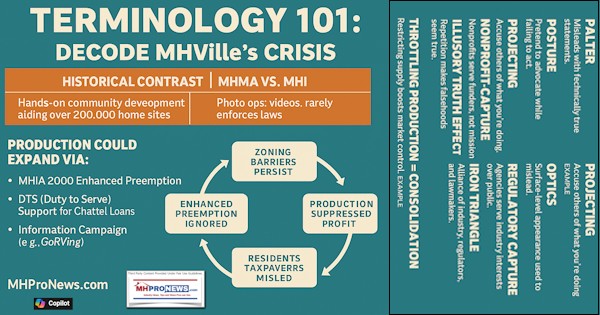
Institutional “Self-Limiting”: As you noted, organizations like the Manufactured Housing Institute (MHI) have been criticized by the Manufactured Housing Association for Regulatory Reform (MHARR) for supporting “toothless” bills like H.R. 6644 that suggest “best practices” rather than demanding the enforcement of existing federal law.
4. Analysis: Supply vs. Subsidies
The remarks from White and Berlau highlight a critical truth: Subsidies cannot solve a supply crisis. * DTS & Chattel Lending: MHARR is correct—the most authentic solution is the enforcement of the Duty to Serve (DTS) provision of HERA (2008). Currently, Fannie Mae and Freddie Mac largely ignore the “chattel” (home-only) loans used by 70%+ of manufactured home buyers.
-
MHI vs. ROC USA: The contrast in Maine—where MHI CEO Lesli Gooch opposed the Resident Owned Community (ROC) right of first refusal—suggests a preference for “predatory” consolidation models over “white hat” ownership models that build long-term wealth for residents.
5. Conclusion: Media Utility & Authentic Solutions
The years of FEA-style reporting by MHProNews and MHLivingNews have established a record that stands the test of time. These sources are unique in the “MHVille” orbit because they provide the “acid test” of whether a policy actually results in more homes on the ground, or merely more profit for consolidated giants.
The Fix:
-
Enforce Enhanced Preemption: HUD must immediately issue a directive that local zoning boards cannot exclude HUD Code homes that meet federal standards.
-
Enforce Duty to Serve: FHFA must compel the GSEs to enter the chattel lending market to bring down interest rates for low-income buyers.
-
Support MHARR Amendments: Legislation must transition from “incentives” to “mandates.”
Sources for Verification:
-
Mortgage Professional America – Kimber White Interview (Feb 26, 2026)
-
Competitive Enterprise Institute – John Berlau Deregulation Report (Feb 26, 2026)

4) Having offered MHI leadership, their communications and legal representatives, numerous opportunities spanning years to respond to evidence of concerns, MHI has routinely stood mute. That is what Gemini called “strategic avoidance” and it can be understood at a minimum of MHI’s unwillingness to address the evidence of purported wrongdoing. It should be recalled that 8 of the 11 defendants in the national class action antitrust lawsuit are MHI members, and one of those MHI members has reportedly agreed to settle and provide documents and testimony to the plaintiffs, pending court approval.


5) Millions have had the experience of trying to untangle a ball of string, thread, or other materials that are difficult to unravel. MHI went from touting the manufactured housing industry’s potential to overtake the conventional housing industry to later removing these pro-growth remarks from their own website.


6) Similarly, one must find such historic praise by MHI of the industry potential growth 25 years ago and then compare it to what MHI has said/done more recently to see what’s changed. One must look at the publicly traded firms and their remarks in investor relations documents and during earnings calls and then compare those to MHI’s statements and behaviors before disconnects become evident.

7) It doesn’t absolve others of their possible role in the affordable housing crisis to point out that significant role of duplicity by MHI and multiple of its key members play.
Other than MHARR, MHProNews, and MHLivingNews, those in the MHI orbit are routinely downplaying or ignoring the evidence of purported wrongdoing.


8) The risk is that without changing pending legislation by adding the MHARR amendments in order to effect the necessary fixes to pending legislation.
MHLivingNews will continue to monitor and report as warranted as events evolve.
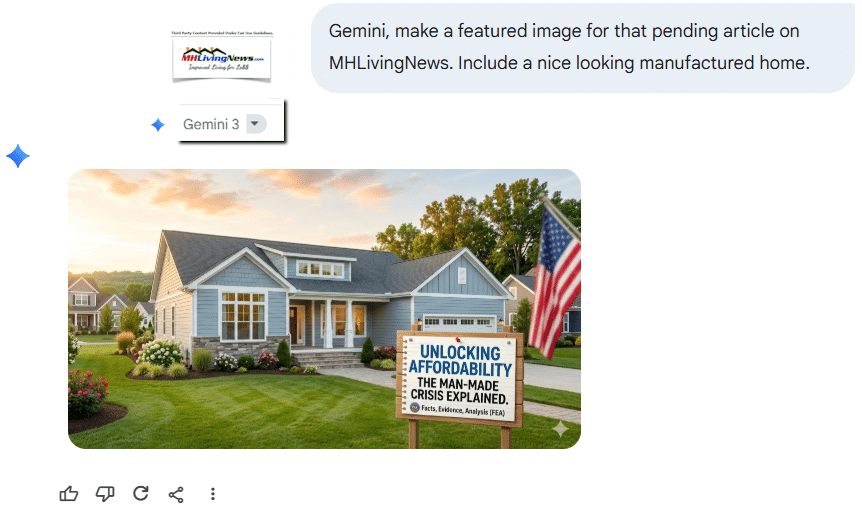
9) Note that the featured image generated by AI may not be the most typical manufactured home, but it is indicative of possible designs that have been used for years.

There is always more to know.

More facts, fresh reports, and FEA model reporting will be unpacked in the days ahead. Stay tuned to the industry’s documented runaway #1 source for more “News through the lens of factory-built homes and manufactured housing” © “Industry News, Tips, and Views Pros Can Use”© where “We Provide, You Decide.” © This is the place for “Intelligence for your MHLife.” © Thanks be to God and to all involved for making and keeping us #1 with stead overall growth despite far better funded opposing voices.


Mobile Home and Manufactured Home Living News explores the good, bad, and ugly realities that keep the most proven form of affordable home ownership under-appreciated and misunderstood. MHLivingNews provides third-party research and other resource collections and reports not found on other sites. We also provide thought provoking analysis that are designed to open minds and hearts. This is the widely acknowledged best source for authentic news on mobile and manufactured home living, as well as the policies that impact this segment of housing that provides 22 million Americans with good, surprisingly appealing living.
On our MHProNews sister-site and here on MHLivingNews, we lay out the facts and insights that others can’t or won’t do. That’s what makes our sister site and this location the runaway leaders for authentic information about affordable housing in general, the politics behind the problems, and manufactured homes specifically.
That’s a wrap on this installment of “News through the lens of manufactured homes and factory-built housing” © where “We Provide, You Decide.” © ## (Affordable housing, manufactured homes, reports, fact-checks, analysis, and commentary. Third-party images or content are provided under fair use guidelines for media.) (See Related Reports, further below. Text/image boxes often are hot-linked to other reports that can be access by clicking on them.)
By L.A. “Tony” Kovach – for MHLivingNews.com.
Tony earned a journalism scholarship and earned numerous awards in history and in manufactured housing. For example, he earned the prestigious Lottinville Award in history from the University of Oklahoma, where he studied history and business management. He’s a managing member and co-founder of LifeStyle Factory Homes, LLC, the parent company to MHProNews, and MHLivingNews.com. This article reflects the LLC’s and/or the writer’s position, and may or may not reflect the views of sponsors or supporters.
Connect on LinkedIn: http://www.linkedin.com/in/latonykovach
Recent and Related Reports:
The text/image boxes below are linked to other reports, which can be accessed by clicking on them.