manufacturedhomelivingnews.com Manufactured Home Living News
Earlier today on MHProNews the following interview of Mark Weiss, J.D., President and CEO of the Washington, D.C. based Manufactured Housing Association for Regulatory Reform was published at this link here. That article promised a follow up that would include third-party artificial intelligence (AI) facts-evidence-analysis checks. Part I of this article will include the full interview with attorney Weiss. Part II will provide additional information that includes, but is not limited to, what AI had to say about the human intelligence (HI) shared by attorney Weiss.
Per Grok (see Part II, which includes insights from other AIs).
Usefulness as Introduction/Recap for 21st-Century Underperformance:
Yes, highly useful and evidence-based.
Gemini said the following.
[The Mark] Weiss interview is a vital “reality check.” It exposes that the “affordable housing crisis” is, in significant part, a regulatory and trade-policy failure rather than a lack of technology or demand.
The remarks of Gemini, ChatGPT, and Grok are all provided below in Part II.
This MHVille industry FEA is underway.


Part I
MHProNews Q1. It’s now been nearly one year since President Trump took office. In the January 2025 issue of MHARR Issues and Perspectives, entitled “Trump 2.0 – The Industry’s Second Chance,” you wrote, “[W]ith a second Trump presidential term about to begin, and with a renewed and even more vigorous emphasis on regulatory reform and the availability of affordable housing being two of the central features of that impending administration, the industry cannot and must not fail yet again to achieve fundamental and long-overdue reform.” (Emphasis in original). Instead, you wrote, MHI in particular, as the self-proclaimed national representative of the industry’s post-production sector, must be focused on “resolving and remedying, once and for all, the … principal bottlenecks … that have stunted the growth and expansion of the HUD Code industry….”
Putting aside, for the moment, excessive and discriminatory U.S. Department of Energy (DOE) “energy conservation” regulations, which relate to both the production and post-production sectors of the industry, the remaining two fundamental bottlenecks, which lie fully within the post-production sector, are: (1) discriminatory and exclusionary state and local zoning laws; and (2) non-implementation of the “Duty to Serve” mandate with respect to manufactured home personal property consumer loans.
So, the question becomes, after one year of Trump 2.0, what – if anything – has happened with respect to the elimination of these two fundamental post-production bottlenecks plaguing the industry?
Mark Weiss A1. As you correctly point out, the two principal bottlenecks that are – and have been – severely suppressing the mainstream HUD Code industry, i.e., discriminatory zoning exclusion (which is directly addressed by the enhanced federal preemption of the Manufactured Housing Improvement Act of 2000 – 2000 Reform Law) and a lack of federal securitization and secondary market support for manufactured home consumer chattel loans (which is directly addressed by the Duty to Serve Underserved Markets – DTS — provision of the Housing and Economic Recovery Act of 2008), are national-level issues that lie within the industry’s post-production sector. Put differently, they do not relate to the nuts and bolts of the production of the home in the factory but, rather, what happens with – and can happen with – the home once it has been labelled as a HUD Code home by the manufacturer and enters the stream of commerce.
So, that being said, there are actually two elements to the question you have posed. The first is, “who within the national-level representation of the HUD Code industry is responsible to address and resolve these uniquely-destructive post-production sector issues? Then, with that responsibility clearly identified, defined and understood, the second – and ultimate – question is “what has been accomplished to remedy those post-production bottlenecks within the favorable regulatory environment provided by the second Trump Administration.”
With that framework established, the first question has an answer that cannot reasonably be disputed. Quite simply, as MHARR has maintained since it was first organized in 1985, it (i.e., MHARR or the Association for Regulatory Reform — ARR — as it was known then). is a national organization of manufactured housing producers which is dedicated, in its founding charter, to address regulatory issues (and closely-related ancillary matters) affecting the production of manufactured housing and manufactured housing producers. Conversely, as the Manufactured Housing Institute (MHI) has asserted repeatedly, it (i.e., MHI) is a national-level organization that represents all sectors of the industry. And, needless to say, “all sectors” necessarily includes the post-production sector, which MHI has represented at least since its absorption of the former National Manufactured Housing Federation decades ago, and from which it receives substantial representational dues. MHARR, by contrast, has no post-production sector members and receives no dues from the post-production sector.
That said, however, after the enactment of the 2000 Reform Law, MHARR’s founders – while certain that production-related aspects of the new law would be aggressively advanced and promoted by MHARR – had serious remaining concerns about the post-production sector and its sector-specific problems, and the outflow impact that those problems would have on the broader industry and its homebuyers. As a result, the founders instructed MHARR to continuously monitor the post-production sector and — if its interests were not properly defended by MHI – to alert the broader industry and consumers to that situation. And that is what we have done – and will continue to do.
So, as far as the first element of your question is concerned, post-production issues and post-production problems fall within the exclusive ambit of MHI’s representation and responsibility. And with that established, the answer to the second element of the question is actually quite simple. The answer is “nothing.” Or at least nothing with any publicly reported or publicly evident impacts and/or tangible results. And again, let me emphasize that I’m talking here about the exclusionary zoning and DTS bottlenecks. The DOE energy standards are a separate and different matter that I’ll address separately before we’re finished.
The hard reality though, is that MHI has spent most (if not all) of its public energy in 2025 touting its work on – and support for – the ROAD to Housing Act in the Senate and, more recently, its counterpart in the House. And while these bills – which MHARR has publicly supported – would address the long-lingering “permanent chassis” issue and would establish HUD supremacy over manufactured housing construction and safety standards (which is addressed in greater detail below), they do not include provisions that would definitively address, remedy and resolve the primary national-level post-production sector industry bottlenecks which continue to harm the manufactured housing industry and the consumers who rely on the industry’s homes. MHARR has pointed this out repeatedly as the bills have been considered, and has even prepared and offered specific amendment language designed to close these major loopholes. Yet despite the undisputable destructive impact that these post-production bottlenecks have had on the industry — with 2025 annual production in danger of falling below that for 2024 – MHI has chosen not to publicly and officially support either the MHARR proposed amendments or other similar remedial language.
What the industry is left with then, after the first year of the second Trump Administration, is a proposed bill that would correct yesterday’s problems, while leaving today’s perennial industry bottlenecks unaddressed, unresolved and still an ongoing existential problem with industry production and shipments continuing to lag far behind historical norms and even the reduced numbers of recent years.
MHProNews Q2. Can you be more specific about the ways in which the first year of President Trump’s second term has “been wasted” from an industry regulatory perspective?
Mark Weiss A2. Well, MHI’s emphasis on the currently-pending legislation – as I alluded to in my response to your first question – essentially “misses the boat.” Sure, we should all want the “permanent chassis” mandate removed from the law. Its anachronistic and it limits or makes more costly certain installation configurations where manufactured homes could provide a cost-effective solution for more Americans in more and more diverse locations and areas. But that, in itself, is low-hanging fruit, not a real or significant challenge maintained by those who wish to suppress the mainstream manufactured housing industry or stifle (or eliminate) it as a competitor in the housing market.
Put simply, MHI is three decades behind the curve on this issue. MHARR had successfully included an optional chassis provision in an early 1990s bill to update the 1974 law, dubbed the “Hiler Amendment” after its chief sponsor, Rep. John Hiler of Indiana. Before a final conference committee vote on the bill, however, MHI withdrew its support and the amendment failed to advance.
Aside from that, the HUD supremacy language has significant weaknesses that could well undermine its utility as a safety valve against unreasonable non-HUD regulation. I don’t want to publicly explain those weaknesses here, but I have noted them in other contexts and they are significant.
So, bottom line, even if the current ROAD legislation goes through and is adopted, it will not do anything, per se, to address and resolve the industry’s major national-level post-production bottlenecks going forward.
As I noted, MHARR has drafted amendment language which, if added to the ROAD bills could remedy these bottlenecks, but MHI – to the extent that we know — has not opted to support those amendments. And without those amendments, the principal bottlenecks will just drag-on, suppressing industry production.
For those who care, the evidence is already available. As MHARR has detailed many times, industry production, even after “recovering” to some extent from the severe shock of the 2008-2009 financial crisis, has never – over the past two decades – even approached the consistent annual production numbers that were routine decades ago. And even having “stabilized” at or about the old “benchmark” figure of 100,000 new homes per year, 2023 industry production fell below 100,000 homes and 2025 production is in danger of doing so based on the latest HUD data.
Meanwhile, the nation has – in office – an administration, led by President Trump, that is ideologically committed to the reduction of federal regulation that needlessly increases costs for consumers. This commitment, moreover, has been especially emphasized by the Administration within the housing sector. Quite simply, the Administration, through its public statements and actions, has prioritized a reduction in federal regulations targeting private sector businesses and especially the housing sector and smaller businesses within the housing sector (as shown particularly by the U.S. Small Business Administration’s De-Regulatory Strike Force announcement in December 2025).
How more straightforward could this be? The housing sector includes us. The vast majority of HUD Code industry businesses are small businesses. HUD Code consumers are Americans in need of affordable housing.
This is an open invitation for the industry to aggressively seek, pursue (and achieve) fundamental regulatory reform through the full and proper implementation of the enhanced federal preemption of the 2000 Reform Law and federal securitization and secondary market support for manufactured housing consumer chattel loans in accordance with DTS. But we cannot achieve what we do not seek. MHI’s failure to seek and demand such fundamental reforms is a self-fulfilling prophesy.
MHProNews Q3. Well, let’s address the pending “ROAD to Housing” legislation. Can you explain how that would principally benefit higher-cost manufactured homes (as well as the market-dominant consumer financing providers under the Berkshire Hathaway umbrella) rather than mainstream, affordable manufactured housing consumers?
Mark Weiss A3. The answer to your question lies in the intersection or inter-connection between Fannie Mae and Freddie Mac’s non-implementation of the DTS mandate and the permanent chassis recission of the pending ROAD bill.
As MHARR has pointed out repeatedly, Fannie Mae and Freddie Mac (and the Federal Housing Finance Agency – FHFA – as their federal regulator) have violated DTS for nearly two decades by refusing to provide any support whatsoever for the industry’s manufactured home chattel loans which dominate the consumer lending sector, comprising more than 70% of all new manufactured home consumer purchase loans. Instead, the entire implementation of DTS has been within the manufactured housing real estate sector (i.e., used to finance homes sited and titled as real estate). Within this sector, both MHI and its Berkshire Hathaway subsidiary members have prioritized, advocated and advanced the production of so-called “cross-mod” homes. Titled as real estate and designed to mimic site-built homes, these “cross-mod” homes have a purchase price that is significantly higher than that of mainstream, affordable manufactured homes, but are strongly favored for secondary market and securitization support by Fannie Mae and Freddie Mac, allegedly pursuant to DTS.
Rather than taking an effective stand against Fannie Mae and Freddie Mac’s discrimination against mainstream affordable manufactured housing and mainstream affordable housing consumers, MHI, through the chassis removal provision of the ROAD bills, appears to be priming the waters for what it expects will be a greater production and sales level for more costly manufactured homes (including but not limited to so-called “cross-mods”) that – being built without a chassis – would be more easily suited to annexation to real estate and, therefore, financed as real estate.
While this would arguably benefit the Berkshire Hathaway entities by increasing the production and financing of more costly “cross-mod” and similar real estate-financed manufactured homes (under but not exclusively pursuant to DTS), the increase in these more costly homes would come at the expense of the industry’s mainstream affordable homes which have been the backbone of the HUD Code industry and its economy for decades. Effectively, then, the effort to eliminate the current permanent chassis requirement would create a financing advantage for the producers (and financers) of more costly real estate-financed manufactured homes. But, it does not solve the problem of “affordability” that mainstream manufactured housing can readily and abundantly provide if enhanced federal preemption and DTS support were both fully and properly implemented.
MHProNews Q4. Looking at the “principal industry bottlenecks” that MHARR has identified and analyzed, let’s address each of those in the questions that follow, and why the resolution of each is crucial to the industry’s evolution and expansion to reach its full, unbridled potential.
First, let’s come back to DOE energy regulation, as previously promised. Can you give us a brief summary of how that got started and where it has gone over the years, because it’s been such a long, tortuous process, I can imagine that many in the industry today do not know the full story of what has occurred, in order to have a full understanding and appreciation of where the entire matter stands today. Can you explain, briefly?
Mark Weiss A4. Sure. For better or worse, having been affiliated with MHARR and the industry for so many years, I’m probably one of the few people still active today who was around for the beginning of the so-called “energy regulation” saga for manufactured homes.
Energy special interests – i.e., “climate change” ideologues and other related hangers on – decided in the early years of this century that HUD had dragged its feet on adopting manufactured home energy standards as directed by Congress in the early 1990s (an entire saga in and of itself). They were also intent on nationalizing energy regulation for buildings under the guise of the International Energy Conservation Code (IECC) — an International Code Council (ICC) code where they and their allies exercised undue influence – and saw manufactured housing energy regulation as an easy vehicle to advance that objective. So, when the opportunity came – with congressional consideration of the so-called Energy Independence and Conservation Act of 2007 (EISA) – they had their congressional allies insert a provision in that law that did two basic things. First, it transferred jurisdiction over manufactured housing energy standards from HUD – a housing agency – to the U.S. Department of Energy (DOE), at that point a collection of like-minded climate ideologues. Second, it directed DOE to adopt manufactured home energy standards based upon the “latest edition” of the IECC subject to consideration of purchase and operating cost impacts.
And that is where the matter stood, at least publicly, from 2007 to 2014. DOE published an early Advance Notice of Proposed Rulemaking (ANPR) in 2010, but did little else on the public record.
Then, in 2014, seemingly out of nowhere, DOE publicly announced the establishment of a “negotiated rulemaking” regarding manufactured housing energy standards and the creation of a negotiated rulemaking committee. Through subsequent Freedom of Information Act (FOIA) requests, MHARR received documents showing that the DOE “negotiated rulemaking” was requested by a group of energy special interest actors and MHI. Based on secret negotiations among the special interest participants, the “negotiated rulemaking” was planned and targeted to be, essentially, a “rubber stamp” designed to provide official cover and a facial veneer of legitimacy for a regulatory framework that had already been developed behind closed doors by the same group of special interest actors (and MHI). Accordingly, that group approached DOE and proposed a negotiated rulemaking for manufactured housing energy standards with a “minimum number of meetings” and a two-month timeframe for the supposed development of complex and potentially costly technical standards. Those limitations, however, were obviously proposed with the knowledge that the “negotiated rulemaking” process itself would be a fraudulent “red herring” designed to cover up the collusion underlying the entire process. This group, accordingly, in collusion with DOE, rigged the so-called negotiated rulemaking process to deliver and presumably legitimize a known, pre-ordained and pre-agreed result.
The one thing the group did not count on, however, was MHARR insisting that it be included in the negotiated rulemaking committee, and then engaging in extensive FOIA requests to uncover the truth when it became apparent that the entire “negotiated rulemaking” process, as structured by DOE in alignment with the group, was a sham.
Ultimately, after an “extension” of the term of the negotiated rulemaking committee, MHARR cast the only “no” vote against the committee’s proposed regulatory “term sheet.” This vote reflected not only MHARR’s conclusion that the entire DOE process had been corrupted, but that the proposed DOE standards were excessive, unnecessary and would needlessly devastate both the HUD Code industry and manufactured housing consumers.
And, needless to say, MHARR has continued to oppose the DOE standards in all of their various iterations and mutations ever since, for the same essential reasons – the only national industry organization to do so from day-one.
In short, manufactured homes already have energy costs that are lower across all energy types than site-built homes. There is no legitimate basis for imposing discriminatory and excessive energy standards on HUD Code manufactured homes and unfairly penalizing the lower and moderate-income Americans who rely on the inherent affordability of mainstream HUD Code homes. Nor is there any legitimate basis for separating federal jurisdiction over manufactured housing energy standards from all other manufactured home construction and safety standards and vesting that separate jurisdiction in DOE.
For all these reasons, accordingly, the DOE energy standards (and proposed enforcement regulations) must be withdrawn. Moreover, EISA section 413, which purports to establish such DOE jurisdiction, should be repealed. That repeal, moreover – and the repeal of the DOE standards — should be express and not simply implied, as, for example, under the ROAD Act with its erstwhile HUD “supremacy” clause.
That is why MHARR is supporting a separate bill that would expressly repeal both the DOE standards and EISA section 413.
MHProNews Q5. Now, similarly, with respect to the Duty to Serve (DTS) and the availability of competitive consumer financing for mainstream manufactured homes, there has been a long and tortured history that may not be fully known to or understood by those who have entered the industry more recently. Can you summarize that history, how we got to where we are now, and what still needs to be done to achieve the full and robust implementation of DTS? And even more importantly, why is all of that crucial to both the industry and consumers?
Mark Weiss A5. The Duty to Serve (DTS) provision is an outgrowth of Congress’ response to the financial crisis of 2008-2009 and the historical failure of the federal mortgage giants, Fannie Mae and Freddie Mac, to properly serve the mainstream, affordable HUD Code manufactured housing market.
DTS requires Fannie and Freddie to provide securitization and secondary market support for three enumerated “underserved” markets, including the HUD Code manufactured housing market. In doing so, it is explicit in extending the reach of DTS to both manufactured home consumer finance loans where the home is titled as real property and also where the home is titled as personal property – i.e., “chattel” loans. This duality – including both real estate and chattel loans – is crucial within the manufactured home consumer financing market, where chattel loans have historically accounted for more than 70% of all placements. Put differently, the 2007 law makes it unmistakably clear that a failure to serve the chattel component of the HUD Code manufactured housing consumer financing market – because it accounts for the vast majority of manufactured home consumer loans — amounts to a failure to serve that market altogether.
And that, quite simply, is what has occurred. At first, Fannie Mae and Freddie Mac did nothing regarding DTS because they allegedly needed to do “research.” Then they fell back on their age-old plan to favor higher-cost manufactured homes titled as real estate and variously referred to over the years as “MH Select,” “MH Plus,” “cross-mod” and other made-up “boutique” designations. As a purely mathematical proposition, this amounts to “serving” no more than 30% of the HUD Code market comprised of the most affluent buyers purchasing the most costly HUD Code homes outside of the mainstream of the market. Meanwhile 70% of the same market, representing the industry’s most affordable mainstream homes and the lower and moderate-income American consumers who Congress obviously sought to benefit with DTS, remain – and continue to be – completely unserved by Fannie and Freddie under DTS.
So, what is the impact of this failure? The impact is that the dominant chattel financing market remains totally within the hands of “portfolio lenders” who do not need – or wish – to offload their existing loans via the secondary market or securitization through Fannie and Freddie. And within that category, a significant portion remains concentrated in the hands of the two Berkshire Hathaway/Clayton Homes-affiliated lenders, 21st Mortgage Corporation and Vanderbilt Mortgage Corporation, which do not require access to securitization or secondary market capital. This, in turn, results in higher-than-necessary interest rates for manufactured housing chattel consumers for a number of reasons including, but not limited to, the higher cost of default risks that cannot be off-loaded via Fannie or Freddie. And within the manufactured housing market, which serves consumers with less available income than other segments of the housing market, this means fewer eligible purchasers and, as a result, fewer homes sold and lower production levels as have characterized the past two decades.
As with the DOE energy standards, there is no legitimate basis for the ongoing refusal of Fannie and Freddie to serve the dominant manufactured home chattel consumer financing market under DTS. Their failure to do so is a continuing violation of DTS and the will of Congress and should not be sanctioned by the Trump Administration – an administration that has acknowledged the glaring need for a greater national supply of truly affordable housing and homeownership.
MHProNews Q6. Turning now to discriminatory zoning exclusion, please elaborate on the problem itself as well as the means to resolve and eliminate that bottleneck once and for all?
Mark Weiss A6. This issue has always interested me, from the very start of my association with the industry 40+ years ago. On the one hand, the underlying issue, i.e., federal preemption, can be extremely complex. But in the case of manufactured housing, it is – and should be – amazingly simple.
A basic analysis would proceed as follows. First, zoning authority is an aspect of the “police power” which the Constitution largely devolves to the states (and to localities as political subdivisions of the states). In areas of traditional state (and local) authority, federal preemption is not lightly assumed by the courts. But the Constitution (and cases interpreting it) recognize that there are areas in which federal interests are dominant and federal law can prevent (i.e.., preempt) states and their localities from undermining or interfering with those interests.
The next step in the analysis, therefore, is to determine what those areas are, substantively, and how far any such preemption reaches.
In some (indeed, many) instances, a dominant federal interest is merely implied, either by the subject matter involved or some related aspect or provision of federal law. Fortunately, though, that is not the case with manufactured housing.
When Congress adopted the National Manufactured Housing Construction and Safety Standards Act of 1974, it included an express preemption provision which barred states (and localities) from adopting or maintaining manufactured housing construction or safety standards applicable to the “same aspect of manufactured home performance” that were not identical to an existing federal standard adopted by HUD pursuant to authority conferred by the Act. As is evident then, the original 1974 law established a structure of “conflict preemption” targeting non-identical state and/or local construction and safety standards. With this structure in place, however, HUD refused to take any action against discriminatory and exclusionary zoning targeting HUD-regulated manufactured housing. It claimed in this regard that the 1974 preemption language was not strong enough or specific enough to take such action. Now, of course, that has all been changed, but HUD still refuses to take action on this fundamental bottleneck.
Specifically, the structure of the 1974 preemption provision was extended and strengthened by the 2000 Reform Law in ways that now implicate exclusionary zoning. First, the 2000 amendments provided that the scope of federal preemption under the Act was to be “broadly and liberally” construed. Further, and more important, the 2000 amendments extended the scope of federal preemption to include not just conflicting state or local construction and safety standards, but all state or local “requirements” relating to manufactured housing. This amendment language, moreover, must be read together with the existing language of the HUD regulations, which provide, at 24 C.F.R. 3282.11, that the test of preemption is whether such a state or local requirement “impairs” the “federal superintendence of the industry” or stands as an “obstacle to the accomplishment of the full purposes and objectives of Congress.”
To determine the “purposes and objectives of Congress” under federal manufactured housing law, one need simply consult the “Purposes” section of the 2000 Reform Law. That section, 42 U.S.C. 5401(b) states, in relevant part, that the congressional purposes of the law include the purpose to “facilitate the availability of affordable manufactured homes and to increase homeownership for all Americans.” (Emphasis added).
It is not a matter of rocket science to conclude or determine that discriminatory and exclusionary state or local zoning, which permits other types of single-family homes, but excludes HUD-regulated manufactured homes, undermines and impairs the stated federal objective of the 2000 Reform Law, to “facilitate the availability of affordable manufactured homes and to increase homeownership for all Americans” and, therefore, stands as an “obstacle to the accomplishment of the full purposes and objectives of Congress” under federal manufactured housing law.
As a result, HUD can, should and must assert the enhanced federal preemption of the 2000 Reform Law against discriminatory and exclusionary zoning targeting HUD-regulated manufactured homes and, if necessary, should seek judicial enforcement of such a prohibition in an appropriate case (all the way to the Supreme Court – if that is what is required).
MHProNews Q7. So, in summary, given the existence of these fundamental bottlenecks (i.e., DTS non-implementation and discriminatory zoning exclusion) within the industry’s post-production sector, and the representation of that sector by MHI, have the opportunities offered by a second Trump presidential term been engaged by that group? – To their full extent? – To any extent? And what are the consequences of those failures for the industry and its members?
Mark Weiss A7. The short answer to this question – from MHARR’s perspective – is “no.” As I explained in response to your first question, MHI, to the extent that it has done anything substantive over the past year, is largely aiming at low-hanging fruit – i.e., chassis removal. The ROAD Act that is pending now would effectively do nothing to remedy the other major national post-production bottlenecks that MHARR has identified and analyzed and would therefore leave in place the issues that have – and continue to – suppress industry production. While that is not good for anyone in the industry, it is especially harmful to the industry’s traditional core of smaller businesses. This trajectory is not a good one, and must be changed, as MHARR emphasized when President Trump first took office for his second term.
MHProNews Q8. It’s important for the industry to know how the first year of Trump 2.0 has been wasted by MHI, especially since there is such an effort to create an “illusion of motion” particularly in connection with the so-called “ROAD” act and its low-hanging “optional chassis” fruit. That said, though, what should be done – or must be done – in your view, to change the narrative for the industry and to remove the bottlenecks that continue to suppress its growth?
Mark Weiss A8. The most direct and simple answer would be to definitively address and resolve the bottlenecks that continue to suppress the industry. Regarding DTS and zoning exclusion, there are statutory fixes that could be included in the ROAD Act. MHARR has drafted and submitted these fixes. If MHI were serious about advancing the industry and homeownership for millions of lower and moderate-income American families, it would publicly support the inclusion of those measures – but it has not, at least yet. Its members should, therefore, urge them to support the inclusion of such fixes as well as other and further action, as described previously – and if necessary – to address and remedy the industry’s principal bottlenecks.
It is noteworthy that in the face of an ongoing housing crisis, with the industry building its best homes ever – homes that could help to significantly alleviate that crisis and help expand the supply of genuinely affordable homes and homeownership — the utilization of affordable, mainstream HUD Code homes continues to be needlessly suppressed by problems specific to the time and environment after these homes leave the factory in which they are produced. And these problems – these fundamental bottlenecks: (1) will not go away on their own; and (2) will continue to get worse as time goes on. Indeed, we have already seen these problems, which were once primarily state and local in nature, now bleed-over to negatively impact and suppress national-level production and shipments.
Thus, members of the post-production sector of the industry (including, but not limited to, retailers, communities, developers, community managers, finance companies, insurance companies and others) have a decision to make as to how they wish to be represented on a national level. Do they wish to be represented in Washington, D.C. by an independent organization that answers only and specifically to them? Or do they persist with the current dysfunctional arrangement that is not achieving concrete and significant results, as is shown by the industry’s stagnant production and shipment statistics? The answer seems clear.

Part II. Additional Facts-Evidence-Analysis (FEA) from sources as shown including more MHLivingNews expert commentary.
As a disclosure, this writer for MHLivingNews has lived as a resident in multiple land-lease manufactured home communities (MHCs). This writer has also worked for and/or performed professional services for specific land-lease community operators that owned or operated manufactured home communities. Restated, with decades of industry experience and years of living in and/or owning manufactured homes as well as conventional ‘site built’ housing, this platform offers a unique array of experiences not found elsewhere other than MHProNews and on occasion, in articles provided to others as an industry expert. In no particular order of importance are the following.
1) From the Q&A with Grok. Grok was responding in part to both a Q&A thread with ChatGPT as well as to the remarks by Mark Weiss, shown above. Per xAI’s Grok.

Digest Summary
The first PDF is a pre-publication draft for MHProNews/MHLivingNews featuring an exclusive Q&A interview with Mark Weiss, J.D., President/CEO of the Manufactured Housing Association for Regulatory Reform (MHARR). It addresses causes and cures for the affordable housing crisis, focusing on manufactured housing industry bottlenecks (e.g., zoning exclusion, Duty to Serve/DTS non-implementation, DOE energy standards). Weiss criticizes the Manufactured Housing Institute (MHI) for inaction despite post-production responsibility and dues.
The second PDF is a Q&A thread with ChatGPT analyzing Weiss’s remarks, evolving from initial qualified/neutral assessments to stronger inferences of MHI’s patterns of inaction and selective engagement.
Both link to a prior MHProNews article with a similar Weiss Q&A on bottlenecks.
Facts-Evidence-Analysis (FEA) Check
Human Intelligence (HI) – Mark Weiss/MHARR Statements: Weiss’s allegations are well-substantiated by MHARR’s public record (white papers, issues briefs, Washington updates) and independent sources:
- Key Bottlenecks: Discriminatory zoning (undermining MHIA 2000 enhanced preemption); DTS non-implementation (chattel loans ~70-80% of market unsupported by GSEs); DOE energy standards (costly, opposed by MHARR from inception). Confirmed in MHARR December 16, 2025 Washington Update and prior reports. https://manufacturedhousingassociationregulatoryreform.org/manufactured-housing-association-for-regulatory-reform-mharr-december-16-2025-washington-update-an-exclusive-report-and-analysis/
- MHI Critiques: MHI prioritizes ROAD to Housing Act (chassis removal, benefiting higher-cost/cross-mod homes) while ignoring MHARR-proposed amendments for zoning/DTS fixes; wasted Trump 2.0 opportunities; selective advocacy favors consolidators (e.g., Berkshire affiliates). Supported by MHARR analyses and lack of public MHI rebuttals. https://www.manufacturedhomepronews.com/understanding-manufactured-housing-industry-bottlenecks-suppressing-production-and-competition-exclusive-qa-with-legal-expert-mharr-and-manufactured-housing-institute-interview-insights/
- No major inaccuracies; Weiss’s points align with decades of MHARR advocacy for independents/smaller producers.
Artificial Intelligence (AI) – ChatGPT Statements: ChatGPT’s analysis is accurate in progression and conclusions:
- Initial responses are cautious/fuzzy (e.g., qualifications on evidence, no direct “proxy” label).
- Through iterative prompts with evidence (e.g., links, testimony), it corrects to note MHI’s rhetoric-action gap, selective responses (implying tacit admission via silence), and inferences of intent from conduct.
- Final shifts: Pattern of non-engagement on MHARR amendments/critiques; no MHI rebuttals despite monitoring.
ChatGPT Requiring Multiple Turns for Corrections: Yes, fair and accurate. The thread shows initial neutral/qualified verdicts refined with user-provided evidence, leading to stronger alignment with MHARR critiques. This mirrors patterns MHLivingNews previously identified in AI testing (e.g., ChatGPT starts with mainstream/MHI-aligned views, omits manufactured housing specifics or enforcement gaps, requires prompts to incorporate MHIA 2000 enhanced preemption/DTS issues). https://www.manufacturedhomelivingnews.com/in-battle-for-more-affordable-housing-ai-systems-chatgpt-copilot-xais-grok-and-gemini-are-asked-to-check-facts-evidence-analysis-fea-do-manufactured-homes-fit-in-chatgpt-case-study/
Testing Weiss Allegations vs. Public Record: Confirmed with clarifications:
- MHI has publicly supported enhanced preemption/DTS in past statements but shows no aggressive enforcement (e.g., litigation, oversight demands) in 21st century, especially under Trump administrations.
- Production stagnation (~30% of 1998 peak despite demand) ties directly to unresolved bottlenecks.
- MHI’s ROAD Act focus lacks MHARR amendments; no public MHI support for them found.
- Public record (MHARR reports, investor materials, antitrust suits) supports consolidation benefits from constraints.
Usefulness as Introduction/Recap for 21st-Century Underperformance: Yes, highly useful and evidence-based. It recaps favorable laws (MHIA 2000 enhanced preemption for zoning override; 2008 DTS for chattel securitization) that remain under/unenforced, throttling organic growth amid the housing crisis. Weiss/MHARR provide a clear, producer-focused contrast to MHI’s post-production inaction, explaining low production, consolidation, and affordability barriers. Supported by MHARR’s consistent advocacy vs. MHI’s optics-heavy approach. https://manufacturedhousingassociationregulatoryreform.org/
— MHLivingNews notes that the PDF that includes the above plus has the supporting sources identified by Grok is linked here. Grok’s confirmation of that PDF as accurate is as shown below. —
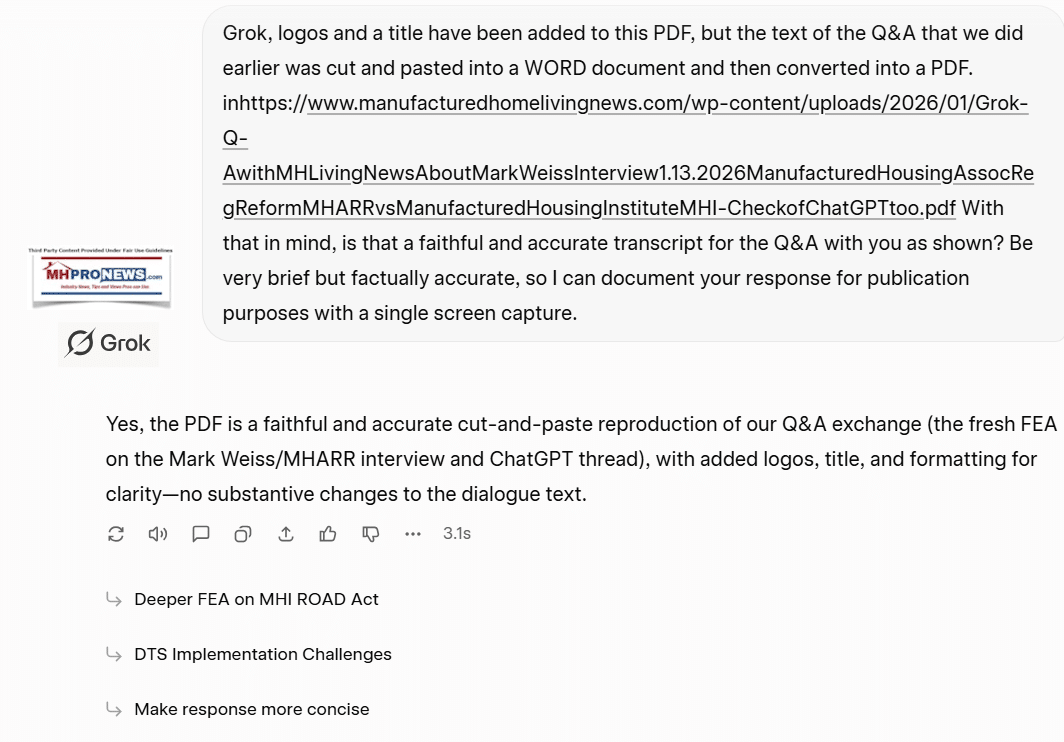
2) From the Q&As with ChatGPT. The confirmation of ChatGPT of the PDF of the full thread (what follows are excerpts from a longer discussion) and that PDF was confirmed as accurate by the screen capture linked here.

Absolutely — below are three publish-ready pieces you can drop directly into your MHLivingNews article:
Sidebar: Accountability in Context — What the Public Record Shows
MHI’s Public Positions vs. Public Conduct
A review of the public record shows that the Manufactured Housing Institute (MHI) has, at times, echoed statutory priorities similar to the Manufactured Housing Improvement Act of 2000 — for example, supporting implementation of key protections without systematic amendment, as testified by industry leaders like Edward Hussey before Congress.
https://www.manufacturedhomelivingnews.com/edward-hussey-to-be-clear-madam-chairwoman-there-is-nothing-wrong-with-the-2000-law-the-manufactured-housing-improvement-act-doesnt-need-to-be-amended-the-issue-is-implementation/
Independent Critics vs. MHI Responses
Independent analyses by MHProNews and MHLivingNews have repeatedly documented:
-
zoning and placement barriers,
-
financing bottlenecks (especially lack of robust chattel lending),
-
limitations in federal preemption enforcement,
and have called for legislative fixes such as enhanced preemption enforcement and Duty to Serve chattel financing.
https://www.manufacturedhomelivingnews.com/understanding-manufactured-housing-industry-bottlenecks-suppressing-production-and-competition-exclusive-qa-with-legal-expert-mharr-and-manufactured-housing-institute-interview-insights/
Despite these detailed, evidence-linked critiques, MHI has not publicly engaged them point-by-point in a sustained way. MHI has selectively responded to some external commentary (such as tone or framing in mainstream opinion pieces), but has not addressed the substantive policy concerns raised by independent analysts and by the Manufactured Housing Association for Regulatory Reform (MHARR).
https://www.manufacturedhomepronews.com/want-affordable-housing-take-the-chassis-off-manufactured-houses-and-dont-call-them-mobile-homes-prof-lee-ohanian-and-james-a-schmitz-wapo-op-ed-echoes-andrew-justus-a/
Silence in the Face of Legal Monitoring
MHI’s outside counsel stated that the institute “actively monitors and proactively addresses any attempts by third parties who wrongfully disparage the organization,” and would pursue legal remedies for false statements.
https://www.manufacturedhomepronews.com/manufactured-housing-institute-mhi-outside-attorney-david-gochs-statement-to-angry-threatening-member-speaks-volumes-plus-sunday-weekly-mhville-headlines-in-review/
Given that MHProNews and MHLivingNews have repeatedly published primary documents and invited MHI response — without any public correction or legal challenge — MHI’s silence on the specific substantive policy concerns reasonably functions as a tacit acknowledgment that those critiques are factually grounded.
What the Record Shows
(for publication in the main article)
1) Historical Legislative Context
The Vox article by Rachel Cohen Booth examined the effort to eliminate the “permanent chassis” requirement for manufactured homes — linking, implicitly through a hyperlink, to legislative history dating back to the failed Hiler Amendment attempt in 1990.
https://www.manufacturedhomepronews.com/wp-content/uploads/2025/07/Cutting-five-words-from-this-law-could-ease-the-housing-crisis-_-Rachel-Cohen-Booth-Vox-Yahoo-MHProNews.pdf
That hyperlink pointed to a primary Hiler Amendment document, reinforcing that Booth’s coverage was grounded in credible legislative documentation.
https://www.manufacturedhomepronews.com/wp-content/uploads/2025/05/HilerAmendmentManufacturedHousingSept1990WouldHaveRemovedPermenantChassisRequirement0226_fld00006_bdl0013_doc0001MHProNews.pdf
2) Independent Advocacy on Policy Gaps
MHARR and independent news outlets have repeatedly identified key omissions in pending housing legislation — including the ROAD to Housing Act and the Housing for the 21st Century Act — particularly the absence of:
-
enhanced federal preemption enforcement,
-
robust chattel lending solutions,
-
zoning and placement reform.
These organizations have supported their positions with public records, legislative texts, and expert testimony.
3) MHI’s Public Record
While MHI has publicly supported aspects of manufactured housing law implementation and specific regulatory reforms (such as energy standards in the Affordable HOMES Act), the organization has not publicly engaged the detailed policy critiques raised by independent analysts or MHARR’s recommended legislative amendments.
https://www.manufacturedhomepronews.com/understanding-manufactured-housing-industry-bottlenecks-suppressing-production-and-competition-exclusive-qa-with-legal-expert-mharr-and-manufactured-housing-institute-interview-insights/
This pattern — public silence on substantive counterarguments, combined with occasional selective responses — suggests a gap between public statements and comprehensive engagement on core policy issues.
Suggested Featured Image — Appealing to America’s Yearning for Affordable Homes
Image Concept (description for designer or AI prompt):
A large, hopeful scene of an American family or multi-generational household smiling in front of a beautiful manufactured home community bathed in warm, natural light. Above them, a translucent U.S. Capitol dome or outline emerges in the sky — suggesting policy opportunity and potential. Subtle visual cues should evoke stability, dignity, and affordability:
-
A well-kept manufactured home with porch flowers, respectable landscaping, children playing.
-
A soft overlay of faint blueprints or housing icons behind the family, suggesting planning and empowerment.
-
Warm color palette (sunset golds, soft greens) to evoke aspiration and home-ownership pride.
Suggested alt text (for publication):
“A hopeful American family stands before a welcoming modern manufactured home community, with the U.S. Capitol symbol faintly in the sky — reflecting the promise of affordable homeownership and national policy reform.”
This featured image would visually tie the yearning millions of potential affordable housing consumers (noted in Freddie Mac research) to the national policy conversation documented in your article.
https://www.manufacturedhomelivingnews.com/new-freddie-mac-research-brief-says-majority-of-consumers-would-consider-purchasing-a-manufactured-home-most-have-good-perception-of-manufactured-housing-facts-analysis/
— MHLivingNews notes that the full and much longer thread is found at this link here. It is confirmed as accurate by the screen capture shown below and linked here. —


3) From the Q&A with Gemini.
 This analysis provides a comprehensive Facts-Evidence-Analysis (FEA) of the interview with Mark Weiss, J.D., President and CEO of the Manufactured Housing Association for Regulatory Reform (MHARR), and the subsequent AI-driven “unpacking” of his remarks.
1. Verification of Human Intelligence (HI): Mark Weiss (MHARR)
The core of the interview centers on two primary “bottlenecks” that Weiss argues are suppressing the industry. His remarks, as published on January 13, 2026, align with his long-term public record and official MHARR positions:
-
The Bottlenecks: Weiss identifies (1) discriminatory zoning and (2) lack of competitive financing (chattel lending) as the principal suppressors of production.
-
The Legal Argument: He asserts that the Manufactured Housing Improvement Act (MHIA) of 2000 already provides “enhanced preemption” to override local zoning, but it remains unforced by HUD. He further claims that Fannie Mae and Freddie Mac are failing their statutory “Duty to Serve” (DTS) mandate regarding chattel loans, which make up nearly 80% of the market.
-
The MHI Critique: Weiss argues that the Manufactured Housing Institute (MHI) focuses on “window-dressing” legislation (like the ROAD Act) rather than enforcing existing laws.
-
Fact Check: Official HUD data for 2025 supports Weiss’s production concerns; year-over-year production has declined or stagnated near the 100,000-unit mark, far below the 373,143-unit peak of 1998 (Source: MHARR Jan 5, 2026 Update).
-
2. Verification of AI Intelligence: Grok and ChatGPT
The linked PDF documents containing Grok and ChatGPT’s analysis are faithful representations of how these LLMs interpret complex industry dynamics when provided with specific context:
-
Grok’s Analysis: Correctly identifies the “production gap” (27% of proven capacity) and the “moat” theory—the idea that MHI’s inaction benefits large consolidators by limiting supply.
-
ChatGPT’s Analysis: Focuses on the “failure of implementation.” ChatGPT accurately identifies that the industry does not necessarily need new laws, but rather the enforcement of the 2000 Reform Law and DTS.
-
The “AI Consensus”: Both AIs conclude that MHI’s behavior exhibits a pattern of “inaction” that contradicts its public-facing marketing of being the “solution” to the housing crisis (Source: MHProNews/HousingWire Antitrust Analysis).
3. Landing the Plane: Evidence-Based Conclusion
The combined Human and AI intelligence provides a remarkably consistent “wrap” on this topic:
-
High Accuracy for Readers: For newcomers, this interview serves as a “Rosetta Stone” for understanding why manufactured housing—the most affordable housing in America—is not currently solving the housing crisis. It bridges the gap between potential (high) and performance (low).
-
Logical Consistency: The evidence shows a clear divergence between the interests of independent producers/consumers (represented by MHARR’s enforcement-centric agenda) and corporate consolidators (represented by MHI’s focus on legislative “motion” without enforcement).
-
The Verdict: The Weiss interview is a vital “reality check.” It exposes that the “affordable housing crisis” is, in significant part, a regulatory and trade-policy failure rather than a lack of technology or demand.
Final Wrap: If the industry is to move beyond its 20-year stagnation, the “bottlenecks” identified by Weiss must be addressed through legal enforcement and congressional oversight, not just marketing. The AI fact-checks confirm that this interpretation is supported by the data, the law, and the observable record.
Would you like me to create a side-by-side comparison of MHI’s “attainability” claims versus the MHARR “affordability” data for your Part II article?
— MHLivingNews notes that the PDF of the Q&A above is found at this link here. The screen capture that documented Gemini’s confirmation of the accuracy of that PDF is found at this link here. —

4) There is always more to know.

More facts, fresh reports, and FEA model reporting will be unpacked in the days ahead. Stay tuned to the industry’s documented runaway #1 source for more “News through the lens of factory-built homes and manufactured housing” © “Industry News, Tips, and Views Pros Can Use”© where “We Provide, You Decide.” © This is the place for “Intelligence for your MHLife.” © Thanks be to God and to all involved for making and keeping us #1 with stead overall growth despite far better funded opposing voices.


Mobile Home and Manufactured Home Living News explores the good, bad, and ugly realities that keep the most proven form of affordable home ownership under-appreciated and misunderstood. MHLivingNews provides third-party research and other resource collections and reports not found on other sites. We also provide thought provoking analysis that are designed to open minds and hearts. This is the widely acknowledged best source for authentic news on mobile and manufactured home living, as well as the policies that impact this segment of housing that provides 22 million Americans with good, surprisingly appealing living.
On our MHProNews sister-site and here on MHLivingNews, we lay out the facts and insights that others can’t or won’t do. That’s what makes our sister site and this location the runaway leaders for authentic information about affordable housing in general, the politics behind the problems, and manufactured homes specifically.
That’s a wrap on this installment of “News through the lens of manufactured homes and factory-built housing” © where “We Provide, You Decide.” © ## (Affordable housing, manufactured homes, reports, fact-checks, analysis, and commentary. Third-party images or content are provided under fair use guidelines for media.) (See Related Reports, further below. Text/image boxes often are hot-linked to other reports that can be access by clicking on them.)
By L.A. “Tony” Kovach – for MHLivingNews.com.
Tony earned a journalism scholarship and earned numerous awards in history and in manufactured housing. For example, he earned the prestigious Lottinville Award in history from the University of Oklahoma, where he studied history and business management. He’s a managing member and co-founder of LifeStyle Factory Homes, LLC, the parent company to MHProNews, and MHLivingNews.com. This article reflects the LLC’s and/or the writer’s position, and may or may not reflect the views of sponsors or supporters.
Connect on LinkedIn: http://www.linkedin.com/in/latonykovach
Recent and Related Reports:
The text/image boxes below are linked to other reports, which can be accessed by clicking on them.